AIOps for Beginners: Training, Tools, Use Cases, and Certification Roadmap
Modern IT environments are moving faster than human operators can think. Consider a typical peak traffic scenario: an e-commerce platform undergoes a sudden localized slowdown, and within seconds, monitoring dashboards light up with thousands of concurrent warnings. The database team blames the network infrastructure, the application developers point to a recent microservice deployment, and the site reliability engineering (SRE) team scrambles to find the signal amid an overwhelming ocean of noise.
This operational state is unsustainable. Alert fatigue, fractured visibility across multi-cloud environments, and the sheer volume of telemetry data make manual incident investigation nearly impossible. When enterprise systems generate gigabytes of performance data every minute, engineering teams require more than just static monitoring charts; they need proactive, contextual intelligence. To bridge this operational gap, progressive engineering organizations are heavily investing in specialized AIOps Training to equip their personnel with automated diagnostic and remediation capabilities. By implementing intelligent automation, modern infrastructure teams can transition from reactive firefights to systematic, predictive system management. Educational institutions like AiOpsSchool provide the necessary frameworks to help infrastructure specialists successfully navigate this technological shift.
Mastering the Basics: What Is AIOps?
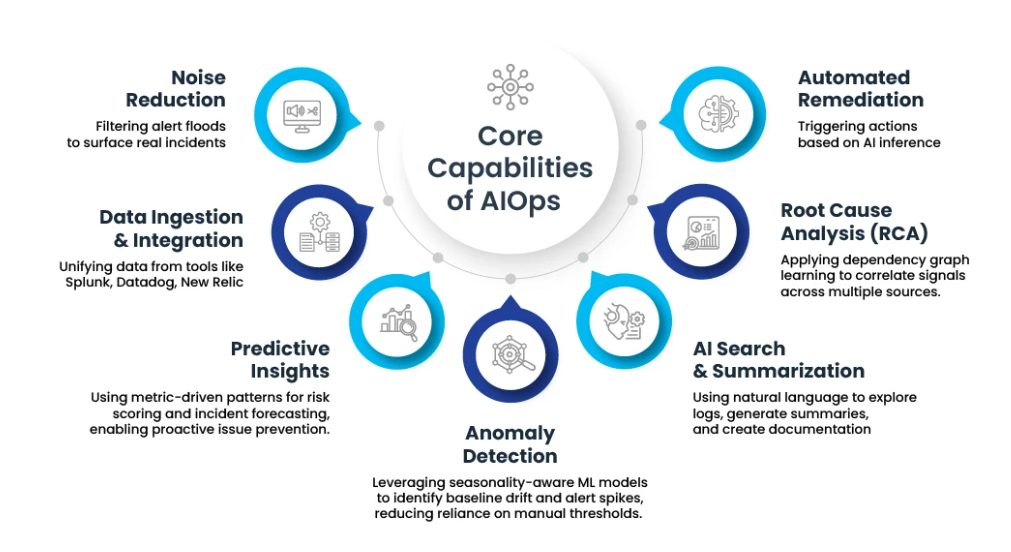
To understand how modern enterprises maintain system uptime, one must first explore how artificial intelligence transforms traditional infrastructure management. What is AIOps? At its core, the term stands for Artificial Intelligence for IT Operations. It represents the strategic deployment of machine learning algorithms, advanced data analytics, and automated workflows directly into the operational heart of an organization's technology stack.Rather than relying entirely on manual human oversight to watch servers and applications, an automated environment utilizes data-driven algorithms to ingest, normalize, and interpret massive continuous streams of operational data. Large-scale enterprise systems are too vast and interconnected for standard human inspection. Distributed software meshes, containerized microservices, and dynamic serverless architectures create millions of moving parts that alter their state every second.An intelligent operations framework functions by establishing an algorithmic baseline of normal system behavior across these environments. When application performance deviates from this baseline, the platform evaluates the anomaly against historical patterns, filters out non-critical background noise, and surfaces the precise underlying issue. By blending mathematical data models with traditional operations pipelines, organizations shift from a model of reactive discovery to one of real-time, continuous operational awareness.
Key Operational Concepts for Enterprise Systems
Navigating the ecosystem of modern IT infrastructure requires a solid grasp of foundational monitoring and automation concepts. Before implementing advanced algorithmic analysis, engineering teams must master the structural components that supply data to intelligent systems.
Observability and Telemetry
Observability is the measure of how effectively you can infer the internal states of a system based entirely on its external outputs. It relies on three primary data forms, collectively known as telemetry:
- Logs: Time-stamped, immutable text records generated by software applications and infrastructure components detailing specific events that occurred at a particular moment.
- Metrics: Numeric values measured over specific time intervals, representing resource consumption parameters such as CPU utilization, memory allocation, network throughput, and error rates.
- Traces: End-to-end data paths that map the journey of an individual user request as it traverses various microservices, databases, and third-party APIs across a distributed ecosystem.
Event Correlation, Baselines, and Anomalies
Once telemetry data is collected, it must be contextualized to become actionable:
- Event Correlation: The algorithmic process of grouping distinct, seemingly isolated system events or alerts that share a common underlying root cause, preventing teams from receiving hundreds of disparate warnings for a single fault.
- Baselines: Dynamically calculated operational profiles that define what healthy system behavior looks like during various periods, accounting for cyclical changes like weekend traffic drops or seasonal promotional spikes.
- Anomalies: Data points or behaviors that deviate significantly from established historical baselines, signaling potential performance degradation or hidden system faults before a total breakdown occurs.
Automation and Remediation
The ultimate objective of collecting and analyzing telemetry is taking swift operational action:
- Automation: The execution of predefined operational tasks, testing workflows, or software deployments without requiring manual human intervention.
- Remediation: The targeted application of automated scripts or runbooks to resolve an active system incident—such as restarting a failing service container or provisioning additional cloud storage—thereby restoring normal operational states instantly.
Foundations for Modern Infrastructure Specialists
The global demand for intelligent automation software and skilled professionals is surging as organizations realize that manual infrastructure tracking cannot scale. Transitioning to modern data-driven infrastructure management requires a tailored approach to AIOps for beginners, focusing on why enterprise landscapes are shifting so rapidly.
- Rapid Career Opportunities: Enterprise engineering teams face an acute shortage of professionals who understand both system operations and applied data engineering. Developing skills in automated anomaly detection and telemetry integration places engineering professionals at the forefront of high-compensation infrastructure design roles.
- Accelerating Technology Trends: The shift toward hybrid clouds, edge computing, and serverless architectures means systems change faster than static alerting rules can be updated. Modern environments require dynamic, self-configuring monitoring solutions that adapt alongside code deployments.
- Widespread Industry Adoption: Major enterprises within financial services, healthcare, e-commerce, and logistics are aggressively phasing out legacy monitoring pipelines. Industry leaders recognize that operational efficiency directly correlates with digital customer retention, accelerating the transition to intelligent platforms.
Structural Distinctions Across Modern Tech Paradigms
As technology teams evolve, the lines between different engineering disciplines can become blurred. To establish operational clarity, it is essential to distinguish between the focus areas, philosophies, and target metrics of different operational methodologies.
An enterprise infrastructure strategy must clearly delineate between AIOps vs DevOps as well as understand the architectural differences found when evaluating AIOps vs MLOps. While DevOps focuses on accelerating the software delivery lifecycle through collaboration and continuous delivery, intelligent operations utilizes data science to optimize the ongoing health of those live production systems. Meanwhile, machine learning operations centers specifically on the development, deployment, and governance of specialized statistical models themselves.
| Concept | Primary Focus | Core Question It Answers | Primary Success Metrics |
| DevOps | Software delivery acceleration and organizational silo destruction. | "How can we safely deploy high-quality software updates to production more frequently?" | Deployment Frequency, Lead Time for Changes, Change Failure Rate. |
| AIOps | Algorithmic telemetry analysis and automated incident response management. | "How can we use machine learning to detect, diagnose, and resolve production failures automatically?" | Mean Time to Detect (MTTD), Mean Time to Resolution (MTTR), Alert Noise Reduction. |
| MLOps | Standardization of machine learning model deployment and training lifecycles. | "How do we reliably retrain, deploy, monitor, and govern our statistical models in production?" | Model Accuracy, Data Drift Metrics, Inference Latency, Pipeline Uptime. |
Understanding these distinctions allows enterprise leaders to align their engineering talent effectively. Rather than expecting software engineers or data scientists to handle complex real-time system failures, teams can deploy specialized infrastructure specialists who leverage intelligent platforms to maximize system availability.
Platform Implementation vs Culture Change
A common pitfall for many enterprises is treating the transition to intelligent operations as a simple software procurement task. Purchasing an advanced analytics platform and connecting it to system logs will not instantly solve incident management struggles. Succeeding with AIOps in IT operations requires an intentional organizational evolution that prioritizes process maturity and deep cultural trust.Technology teams must develop a disciplined operational culture before trusting automated systems to modify live production environments. If an operations group has poorly defined incident resolution workflows, introducing an automated machine learning tool will only accelerate the generation of confused, out-of-context conclusions. Organizations must mature their data collection practices, verify telemetry cleanliness, and break down communication barriers between isolated infrastructure teams.
Furthermore, engineers must build trust in automated remediation. Allowing an algorithm to automatically execute runbooks, restart nodes, or scale cloud footprints requires verification loops and gradual rollouts. Engineers must transition from manual administrators to systemic architects who design, audit, and continually refine the automated logic that governs their infrastructure. Without this cultural shift and comprehensive training, even the most expensive analytics tools will be reduced to expensive, underutilized dashboard displays.
Primary Use Cases for Algorithmic Operations
To appreciate the direct business impact of intelligent systems, one must look closely at specific AIOps use cases. Applying machine learning models to production environments resolves long-standing operational challenges across five major areas.
1. Algorithmic Anomaly Detection
- The Challenge: Static thresholds cause frequent false alarms. For instance, setting a strict 85% CPU alert fails when a database legitimately spikes during a scheduled nightly backup, yet remains silent when a steady 70% utilization indicates a stuck infinite loop on a quiet Sunday morning.
- The Solution: Machine learning models analyze weeks of historical resource data to map multi-variable behavior envelopes that change depending on time, day, and active business cycles.
- Practical Example: An analytics system notes a subtle, uncharacteristic 15% drop in checkout microservice traffic at 2:00 PM on a Tuesday, instantly flagging a broken payment gateway update before customers begin submitting formal complaints.
2. Intelligent Event Correlation
- The Challenge: A localized hardware failure triggers an avalanche of downstream application alerts, burying the primary incident under thousands of secondary error notifications.
- The Solution: Correlation algorithms parse network topologies, application dependencies, and temporal proximities to bundle thousands of related messages into a single operational incident ticket.
- Practical Example: When a core database switch fails, instead of alerting engineers on database latency, application timeouts, web server errors, and storage drops simultaneously, the system presents one single unified alert: "Core Switch Failure."
3. Automated Root Cause Analysis
- The Challenge: Finding the true origin of a multi-system failure requires hours of manual log parsing, log matching, and cross-team interviews during high-pressure incident bridge calls.
- The Solution: Specialized systems perform automated AIOps root cause analysis by scanning code commits, configuration changes, and tracing paths across the exact window when an anomaly began.
- Practical Example: During an active application slowdown, the platform reviews deep system telemetry and identifies that a specific microservice environment variable change, pushed seven minutes prior, caused an unindexed database query loop.
4. Predictive Capacity Planning
- The Challenge: Infrastructure teams typically allocate cloud resources based on guess-driven estimates, resulting in costly resource over-provisioning or catastrophic performance collapses during unexpected traffic surges.
- The Solution: Predictive models evaluate long-term usage trends, business growth data, and seasonal variations to project future hardware and cloud resource exhaustion dates weeks in advance.
- Practical Example: A streaming media infrastructure platform detects subtle growth in compute consumption and automatically alerts storage engineers that cloud-allocated storage arrays will reach maximum capacity in exactly 18 days, giving them ample time to optimize costs.
5. Self-Healing Automated Remediation
- The Challenge: Requiring an on-call engineer to log in at 3:00 AM to execute a trivial, well-known command like clearing a temp directory or restarting a hung service process increases system downtime and driver fatigue.
- The Solution: The platform links anomaly detection directly to verified orchestration scripts, executing remediation workflows safely the moment a known pattern is identified.
- Practical Example: A disk utilization alarm triggers on an application server. The system automatically locates old log archives, compresses them, transfers them to an external cold storage repository, and clears the disk space within seconds without human intervention.
Real-World Operational Success Stories
Examining the operational histories of different market sectors reveals the practical, bottom-line benefits of moving away from legacy monitoring strategies.
Global E-Commerce Architecture
- The Problem: During a global promotional sales event, a major retailer experienced intermittent checkout delays. Their standard alerting tools reported normal status parameters because server hardware stayed within safe utilization thresholds, yet overall transactional conversions dropped by 22%.
- The Detection: An automated analytical tool monitored business transaction metrics alongside system telemetry, identifying an anomalous transaction journey time extension within the inventory verification microservice.
- The Resolution: The platform traced dependencies and discovered that a third-party shipping validation API was timing out, triggering long wait queues in the checkout pipeline. It automatically rerouted checkout traffic to a secondary, backup shipping service.
- The Outcome: Normal transaction processing speeds were restored within four minutes, saving millions in potential lost revenue and preventing further cart abandonment.
Multinational Retail Banking Platform
- The Problem: A commercial banking institution struggled with severe alert fatigue, processing over 120,000 distinct operational alerts every day across their core banking portals. Critical infrastructure failures were regularly missed because engineers were desensitized by continuous non-actionable notifications.
- The Detection: The engineering organization deployed an algorithmic event engine to aggregate telemetry across application layers and mainframe databases.
- The Resolution: By implementing machine learning models to cluster related notifications and filter out normal cyclical background processes, the institution consolidated their daily noise into less than 40 highly accurate, actionable incidents.
- The Outcome: The organization cut their alert volumes by over 99%, dropping their average operational resolution time from over two hours down to eleven minutes.
Enterprise Platform Navigation: Tools You Should Know
Building a responsive, automated operations infrastructure requires selecting and mastering specialized production platforms. Modern engineering teams select their tech stack from a variety of commercial and open-source AIOps Tools tailored to specific observability and processing requirements.To assist engineering architects in navigating the modern software ecosystem, popular technologies can be organized into a structured AIOps tools list sorted by primary operational use case:
- Monitoring & Observability Platforms: Enterprise solutions like Dynatrace, Datadog, and New Relic utilize integrated machine learning engines to automatically discover application topologies, track distributed transactions, and pinpoint anomalous performance regressions in real time.
- Event Correlation & ITSM Engines: Platforms such as BigPanda, Moogsoft, and PagerDuty specialize in ingesting disparate alert feeds from multiple monitoring sources, deduplicating the noise, and applying algorithmic correlation to streamline incident triage and incident response.
- Open Source Ecosystem Components: Teams building customized internal platforms rely on combinations of Prometheus for time-series metric collection, Grafana for visualization, Elasticsearch for centralized log analysis, and specialized Python-based machine learning libraries to execute custom predictive algorithms.
- Cloud-Native Infrastructure Frameworks: Major hyperscalers provide native intelligent operations tools, including AWS CloudWatch Anomaly Detection, Azure Monitor Insights, and Google Cloud Vertex AI for IT operations, designed to optimize scaling behaviors inside proprietary cloud ecosystems.
When working with these enterprise software suites, engineers quickly realize that having access to raw platform features is only half the battle. To gain deep competency, working through a structured AIOps Tutorial represents the most efficient next step for gaining hands-on engineering experience with live data ingestion pipelines, pattern training, and automated webhooks.
Avoidable Pitfalls in Algorithmic Management
Deploying machine learning models into an IT ecosystem can introduce distinct structural problems if executed without proper planning. Engineering leads must watch out for five common mistakes when integrating intelligent automation.
Treating Automation as a Set-and-Forget Architecture
Many teams deploy an analytical platform and assume the algorithm will manage itself indefinitely. Systems evolve, code updates shift behavioral baselines, and cloud environments expand. Teams must continually audit, retrain, and validate their mathematical models to ensure analytical accuracy.
The Lesson: Continuous model calibration is mandatory to ensure analytics match evolving production realities.
Overlooking Telemetry Data Quality
Feeding corrupted, incomplete, or unformatted log files into a machine learning model produces highly inaccurate alerts and missed root causes. If underlying monitoring agents are broken or misconfigured, the predictive engine cannot extract meaningful insights.
The Lesson: The accuracy of your operational intelligence depends entirely on the health of your foundational telemetry data.
Implementing Premature Automation Loops
Enabling automated remediation scripts on systems with poorly understood architectures can trigger destructive operational loops. An algorithm might continuously restart a failing server experiencing an external database lock, worsening system stability.
The Lesson: Validate anomaly identification accuracy manually before authorizing software systems to execute automated infrastructure changes.
Maintaining Disconnected Stakeholder Alignment
When infrastructure teams deploy analytical platforms without consulting application developers or product managers, operational goals become fractured. If business targets are not integrated into automated alerts, system optimizations will miss actual user performance needs.
The Lesson: Align operations metrics directly with overarching business performance goals to ensure system automation drives true user value.
Maximizing Reliability: AIOps for SRE Teams
Site Reliability Engineering focuses on applying software engineering principles directly to infrastructure challenges. Incorporating an intelligent analytics strategy provides a powerful toolset when designing AIOps for SRE programs, fundamentally changing how teams measure and defend system stability.SRE teams live by quantifiable reliability commitments. They measure operational performance using Mean Time to Detect (MTTD) and Mean Time to Resolution (MTTR). When an application fails, intelligent correlation frameworks analyze telemetry data instantly, reducing detection times from hours to seconds. By automatically providing localized root-cause data, these platforms allow engineers to isolate software bugs and execute repairs before users notice performance drops.
[Telemetry Ingestion] ──> [Algorithmic Correlation] ──> [Automated Root Cause] ──> [Runbook Execution]
       │                          │                             │                          │
       ▼                          ▼                             ▼                          ▼
  Raw Log/Metric             Alert Noise                  Exact Policy or             Uptime Safely
   Data Stream                Reduced 99%                  Code Fault Found            Restored (MTTR)
This accelerated workflow directly protects an enterprise organization's Service Level Objectives (SLOs). Instead of exhausting error budgets on avoidable manual service interruptions, SRE teams leverage automated patterns to handle standard infrastructure issues. This shifts engineering focus away from constant firefighting, freeing up time to architect more resilient software deployment pipelines and improve long-term system design.
Detailed Scenario: Seeing Intelligent Operations in Action
To understand the difference between traditional monitoring and algorithmic operations, let us examine a detailed end-to-end simulation of a production incident within a containerized banking platform.
The Problem
At 10:14 AM, a localized memory leak develops inside an updated account authentication service microservice container following a minor mid-day code patch.
The Detection
Traditional static alerting tools would wait until overall host memory crossed an arbitrary threshold like 90%, which might take hours. Instead, the platform's anomaly detection engine notices that the memory usage vector for this specific microservice container is rising at a linear angle that deviates significantly from its historical Tuesday morning trend line. It flags an anomaly immediately at 10:16 AM.
The Correlation
As the memory leak worsens, container response times lengthen. Downstream payment processing applications begin throwing database connection timeouts. Rather than triggering multiple standalone alerts for database teams and application developers, the correlation engine recognizes that all incoming error logs trace back to the same shared authentication transaction ID.
The Root Cause Analysis
The system runs an automated root-cause evaluation. It analyzes the system state changes and maps the performance collapse directly to a specific container version hash code that was deployed via the CI/CD pipeline at 10:10 AM. It marks the newly committed authentication code as the definitive cause of the system failure.
The Remediation
The intelligent platform references an authorized remediation policy runbook. It sends an automated command to the container orchestration engine to safely drain user traffic from the corrupted service instances, roll back the authentication deployment to the stable version from the previous night, and restart the containers.
The Business Outcome
The entire system failure is isolated, analyzed, and completely repaired by 10:21 AM. The total time elapsed from the initial code degradation to complete automated recovery is exactly seven minutes. Human engineers were never required to join emergency bridge calls, customer transactions remained secure, and the organization avoided a costly public outage.
Career Roadmap for Becoming an Operations Expert
Transitioning into an enterprise automation role requires a structured approach to gaining technical skill and validation. Engineering professionals can follow this progressive educational path to build relevant infrastructure expertise:
- Master IT Infrastructure Fundamentals: Develop a strong foundational understanding of networking protocols, Linux systems administration, database management architectures, and containerized deployment ecosystems like Kubernetes.
- Build Deep Observability Fluency: Gain practical experience setting up distributed application telemetry logging, managing Prometheus time-series metric databases, and mapping traces across complex microservice applications.
- Develop Core Algorithmic Concepts: Learn how to apply statistics, machine learning models, predictive analysis, and patterns to high-volume time-series telemetry streams.
- Acquire Hands-On Platform Experience: Work through an enterprise-focused AIOps Course to gain real-world familiarity configuring anomaly detection policies, automated alert rules, and remediation webhooks on active production systems.
- Pursue Formal Industry Validation: Achieve clear professional differentiation by obtaining a verifiable industry AIOps Certification to confirm your skills to global enterprises.
Frequently Asked Questions
What is the value of an AIOps Certification for my career?
Obtaining an industry credential serves as formal validation of your ability to manage complex, modern data-driven monitoring architectures. It demonstrates to global technology employers that you understand both infrastructure engineering and practical data science application, separating you from traditional system administrators.
How does an AIOps Foundation Certification help beginners?
An foundational certification provides early-stage engineers with a clear, structured introduction to core concepts like telemetry collection, event correlation, and automated remediation. It focuses on mastering high-level architectural ideas and terminology before moving into complex script writing and platform programming.
What should I look for in an enterprise-level AIOps Course?
A comprehensive educational program should balance high-level system architecture with rigorous, hands-on software labs. Ensure the curriculum covers telemetry configuration, machine learning baseline calculations, real-world troubleshooting scenarios, and deep integration strategies with modern cloud-native systems.
Are there strong career opportunities available for automation experts?
Yes, global enterprise organizations are experiencing an acute shortage of engineering talent capable of building self-healing infrastructures. Professionals skilled in automated diagnostics, log processing, and algorithmic alerting are highly sought after by financial institutions, cloud providers, and large software companies.
Which foundational software tools should a beginner learn first?
Beginners should start by mastering foundational open-source observability components, specifically Prometheus for gathering performance metrics and Grafana for system visualization. Understanding how to organize and view telemetry data makes it much easier to learn commercial event correlation and anomaly detection tools later on.
Is learning AIOps difficult for traditional DevOps engineers?
DevOps professionals usually adapt quickly because they are already deeply familiar with continuous integration pipelines, application containers, and cloud monitoring tools. The primary learning curve involves understanding how to replace static alert configurations with dynamic, machine-learning-driven analytics and automated remediation workflows.
Why Achieve an Professional Certification?
As enterprise IT architectures become more complex, holding a recognized AIOps Certification provides a significant competitive advantage for modern technology professionals. Relying on general system management experience is no longer sufficient when companies are actively looking for specialists who can build autonomous, self-healing software platforms.
  [Traditional SysAdmin]  ──>  Focus on Manual Scripting & Static Alerts
  [Certified Specialist]  ──>  Focus on Machine Learning Analysis & Self-Healing Engines
Earning an advanced industry credential like an AIOps Foundation Certification provides value across four main areas:
- Validated Technical Authority: It provides objective proof to prospective employers that you possess the advanced skills required to design, deploy, and maintain machine learning models over large production stacks.
- Structured Learning Path: Preparing for a certification keeps your learning focused on industry best practices, preventing you from developing narrow tool-specific knowledge.
- Increased Earning Potential: Organizations are willing to pay a premium for engineers who can significantly lower operational MTTR and eliminate costly application downtime.
- Long-Term Career Growth: Moving out of reactive on-call support shifts your career toward higher-level infrastructure architecture design and strategic engineering management.
Choosing Your Learning Path
Developing competence in automated infrastructure engineering requires high-quality educational resources. Professionals can access targeted training programs through specialized educational frameworks.Prospective infrastructure specialists can choose from multiple learning pathways depending on their career goals:
- Comprehensive Training: Enroll in dedicated programs focused on advanced enterprise metric correlation and automated infrastructure architectures.
- Targeted Skills Courses: Participate in specialized modules designed to teach pattern discovery and telemetry collection across complex software environments.
- Professional Validation Pathways: Prepare for formalized engineering examinations to earn industry-recognized credentials.
- Practical Learning Guides: Utilize hands-on instructional manuals to master tool configuration, data ingestion workflows, and script development.
Engineering teams looking to build deep expertise can find structured curricula covering these exact topics by exploring the specialized training tracks available at AiOpsSchool.
Conclusion
The transition from manual monitoring to algorithmic enterprise automation is a technical necessity for modern digital businesses. As systems scale out, the teams that run them must scale up their capabilities.
Investing in structured education equips infrastructure engineers with the skills needed to design, optimize, and manage autonomous, resilient cloud architectures. Embracing specialized educational programs helps technology professionals advance their careers and ensures enterprise systems remain stable under any conditions. To begin developing your automation expertise and validating your technical skills, explore the comprehensive learning modules and certification paths available at AiOpsSchool.
