Certified AIOps Professional: Building Intelligent IT Operations for the Cloud-Native Enterprise
Introduction: Why AIOps Skills Matter More Than Ever
Modern IT environments are no longer simple, predictable systems. Today’s applications are distributed across cloud platforms, microservices architectures, Kubernetes clusters, APIs, and third-party services. While this architecture improves scalability and agility, it also introduces significant operational complexity.
Every component generates continuous streams of data—logs, metrics, traces, alerts, and performance signals. During incidents, engineering teams often struggle with information overload, where hundreds of alerts appear simultaneously across multiple monitoring tools. The real challenge is not data availability, but extracting meaningful insight quickly enough to resolve issues.
This is where AIOps (Artificial Intelligence for IT Operations) becomes critical. It brings intelligence into IT operations by combining machine learning, automation, and observability to improve how systems are monitored, analyzed, and managed.
The Certified AIOps Professional course offered by AIOpsSchool is designed to help engineers and IT professionals build structured understanding of intelligent operations in real-world systems.
Why the Industry Is Moving Toward AIOps
As organizations scale their digital infrastructure, system complexity increases exponentially. Modern applications are composed of multiple interconnected services, each dependent on others for performance and availability.
In such environments, failures rarely remain isolated. A small issue in one microservice can cascade across the system, affecting user experience and system reliability. Traditional monitoring tools provide visibility but lack intelligence. They generate large volumes of alerts, many of which are redundant or symptom-based rather than root-cause indicators. This creates alert fatigue and slows down incident response.
AIOps solves this challenge by introducing intelligent correlation and analysis. Instead of treating each alert as an independent event, AIOps systems group related signals, suppress noise, and highlight meaningful patterns. This helps engineering teams focus on actual problems rather than raw data overload.
What You Learn in Certified AIOps Professional
The Certified AIOps Professional program is structured to provide a strong foundation in intelligent IT operations. It focuses on practical concepts used in modern engineering environments.
| Learning Area | Description |
|---|---|
| AIOps Fundamentals | Core principles of intelligent IT operations |
| Observability | Logs, metrics, and traces in distributed systems |
| Event Correlation | Connecting related system alerts |
| Anomaly Detection | Identifying unusual system behavior early |
| Incident Intelligence | Improving root cause analysis workflows |
| Automation Concepts | Enhancing operational efficiency using AI-driven systems |
These topics are highly relevant for cloud-native environments where manual monitoring is no longer sufficient to maintain reliability at scale.
Practical Benefits of Certified AIOps Professional
Learning AIOps changes how engineers approach system operations. Instead of reacting to isolated alerts, professionals begin to understand system behavior holistically.
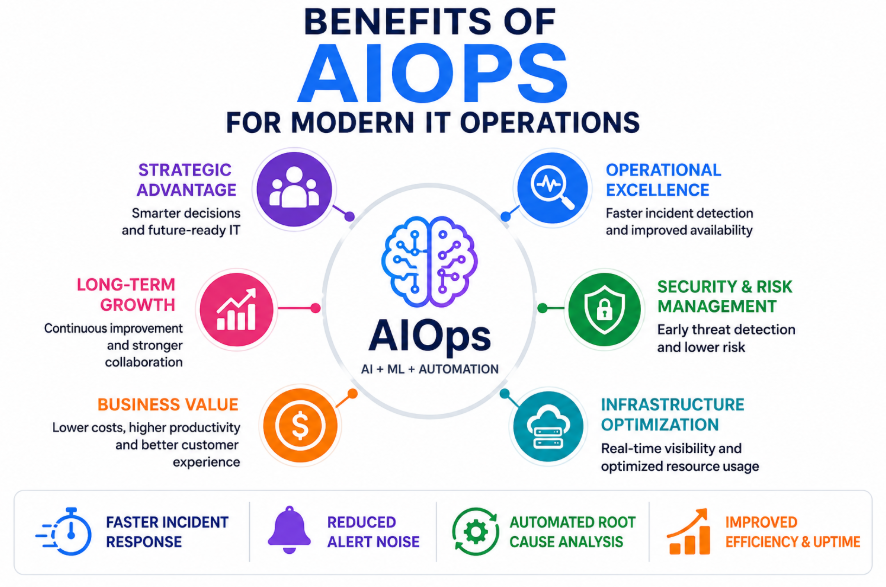
In real-world environments, this leads to faster incident detection, reduced alert noise, and improved root cause analysis. Engineers can resolve issues more efficiently because intelligent systems help filter irrelevant signals and highlight critical insights.
Organizations benefit from improved system reliability, reduced downtime, and better operational efficiency. Engineering teams experience reduced cognitive load and can focus on high-impact incidents rather than alert noise.
Professionals also gain deeper understanding of how distributed systems behave under stress, how failures propagate across services, and how dependencies affect system stability.
About AIOpsSchool and Its Credibility
AIOpsSchool is a focused learning platform dedicated to modern IT operations disciplines such as AIOps, DevOps, Site Reliability Engineering (SRE), cloud operations, observability, automation, and infrastructure management.
In today’s fast-moving technology landscape, structured learning is essential. While online resources provide fragmented knowledge, structured programs help professionals build a complete, connected understanding of systems and operational practices.
The Certified AIOps Professional program is designed to bridge the gap between theory and real-world application by focusing on practical, industry-relevant operational intelligence concepts. As organizations increasingly adopt AI-driven operations, professionals with AIOps expertise are becoming more valuable across engineering and infrastructure teams.
Career Benefits and Real-World Value
The demand for professionals skilled in modern IT operations is growing rapidly. Organizations are actively looking for engineers who can ensure system reliability, scalability, and observability in complex distributed environments.
Software engineers gain deeper understanding of production systems. DevOps engineers enhance automation and monitoring capabilities. Site Reliability Engineers strengthen incident response and reliability practices. Cloud engineers build expertise in distributed systems and observability.
Technical managers benefit from improved visibility into system behavior, enabling better decision-making during outages and performance issues.Key career benefits include:
- Strong understanding of intelligent IT operations
- Improved troubleshooting and incident management skills
- Better alignment with DevOps and SRE practices
- Enhanced observability and monitoring expertise
- Increased relevance in cloud-native engineering roles
As enterprises continue adopting AI-powered operations, these capabilities are becoming essential for long-term career growth.
Common Mistakes While Learning AIOps
A frequent misconception is treating AIOps as purely an automation tool. In reality, it is a broader discipline that integrates observability, analytics, machine learning, and intelligent incident management.
Another mistake is focusing on tools without understanding core concepts such as telemetry, system behavior, and incident workflows. Without these foundations, applying AIOps effectively becomes difficult.
Professionals also underestimate the importance of data quality. Incomplete or noisy telemetry can lead to incorrect insights, even with advanced systems.
Other common mistakes include expecting immediate transformation, ignoring system dependencies, and treating AIOps as a replacement for DevOps or SRE instead of a complementary capability.
Who Should Enroll in Certified AIOps Professional?
This certification is designed for professionals working in modern IT environments where reliability, scalability, and observability are critical.
It is suitable for software engineers, DevOps engineers, Site Reliability Engineers, cloud engineers, infrastructure professionals, platform engineers, technical architects, and IT operations teams.
Engineering managers and technical leaders who want better visibility into system behavior and operational intelligence will also find strong value in this program.
Anyone involved in designing, building, or managing distributed systems can benefit from understanding AIOps principles.
Frequently Asked Questions (FAQs)
What is Certified AIOps Professional?
It is a certification program that teaches how artificial intelligence enhances IT operations through automation, observability, anomaly detection, and intelligent incident management.Do I need prior AI or machine learning experience?
No prior AI/ML knowledge is required. The course is designed for working IT professionals and starts from foundational concepts.Is this useful for software engineers?
Yes. Software engineers gain better understanding of production systems, observability, and real-world system behavior.Does AIOps replace DevOps or SRE?
No. AIOps complements DevOps and SRE practices by enhancing operational intelligence and automation.What career benefits does it offer?
It improves skills in observability, troubleshooting, incident management, and cloud operations, making professionals more effective in modern engineering roles.
Conclusion: Why Certified AIOps Professional Matters Today
As modern IT systems continue to scale, traditional monitoring approaches are no longer sufficient to ensure reliability and performance. Engineering teams need intelligent, data-driven approaches to understand system behavior and respond to incidents effectively.
AIOps represents a major evolution in IT operations by combining intelligence, automation, and observability into a unified operational model. It enables teams to move from reactive troubleshooting toward proactive system management.
The Certified AIOps Professional program provides a structured and practical pathway for professionals who want to stay relevant in today’s cloud-native, DevOps-driven, and reliability-focused engineering landscape.
