DevOps Certified Professional (DCP) Certification Overview
Introduction
DevOps has evolved into a critical capability for organizations operating in cloud-native and distributed environments. Enterprises across the globe rely on automation, CI/CD pipelines, and scalable infrastructure to maintain speed, reliability, and operational efficiency. As DevOps adoption matures, companies increasingly prioritize professionals who can demonstrate structured knowledge and practical implementation expertise. Certification plays a key role in validating that capability.
Why DevOps Certification Matters Globally
Modern DevOps environments require more than tool familiarity.
Employers expect professionals to understand:
- Continuous Integration and Continuous Delivery architecture
- Infrastructure as Code (IaC) implementation
- Container orchestration workflows
- Automated testing integration
- Monitoring and reliability engineering
- DevSecOps best practices
A recognized certification helps bridge the gap between self-learning and enterprise-grade execution.
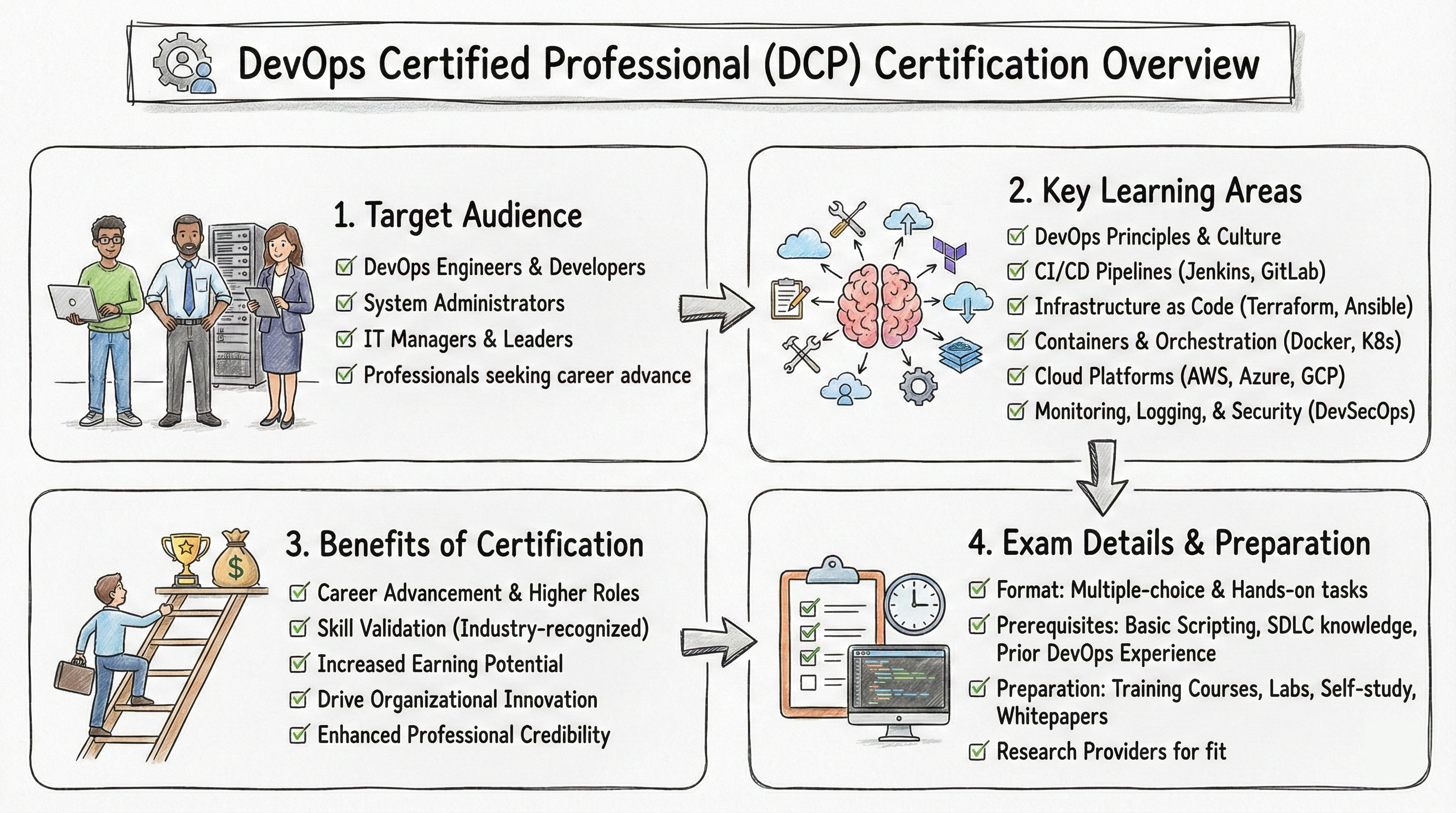
What DevOps Certified Professional (DCP) Covers
The DevOps Certified Professional (DCP) program is designed to align with real-world DevOps lifecycle practices. Instead of focusing only on individual tools, it emphasizes integrated automation and deployment strategy.
Key learning areas include:
- CI/CD pipeline design and implementation
- Infrastructure provisioning using automation frameworks
- Container-based deployment models
- Cloud-native application workflows
- Performance monitoring and logging strategies
- Security integration within DevOps pipelines
The structure supports both foundational clarity and advanced workflow understanding.
About the Certification Provider
The DCP certification is offered by DevOpsSchool, a global training organization specializing in DevOps, cloud computing, automation technologies, and enterprise IT skill development. DevOpsSchool focuses on practical, implementation-driven learning models rather than purely theoretical instruction. Their certification programs are structured around real industry scenarios, making them relevant for professionals targeting international markets and enterprise environments. The organization has trained professionals across multiple regions, helping candidates transition into DevOps engineering, cloud automation, and site reliability roles.
Who Should Pursue This Certification?
The DevOps Certified Professional (DCP) is suitable for:
- Software engineers transitioning to DevOps roles
- Cloud professionals strengthening automation expertise
- System administrators moving toward infrastructure automation
- IT professionals aiming for globally competitive credentials
It is particularly beneficial for those seeking structured learning pathways instead of fragmented online tutorials.
Career and Industry Impact
Global enterprises increasingly rely on DevOps engineers to reduce deployment cycles and improve operational resilience. Certified professionals often benefit from:
- Stronger technical credibility
- Competitive salary positioning
- Improved hiring visibility
- Access to multinational and remote roles
Certification does not replace experience, but it significantly enhances professional positioning in competitive markets.
Final Perspective
DevOps continues to redefine how modern software systems are built, deployed, and maintained. As organizations accelerate digital transformation initiatives, the need for certified and implementation-ready professionals is growing. A structured credential such as the DevOps Certified Professional (DCP) can serve as a strategic step for professionals aiming to build global relevance and enterprise-level DevOps expertise.
