Certified DevOps Manager: Complete Career Success Guide
Introduction: Why the “Certified DevOps Manager” Role Matters More Than Ever
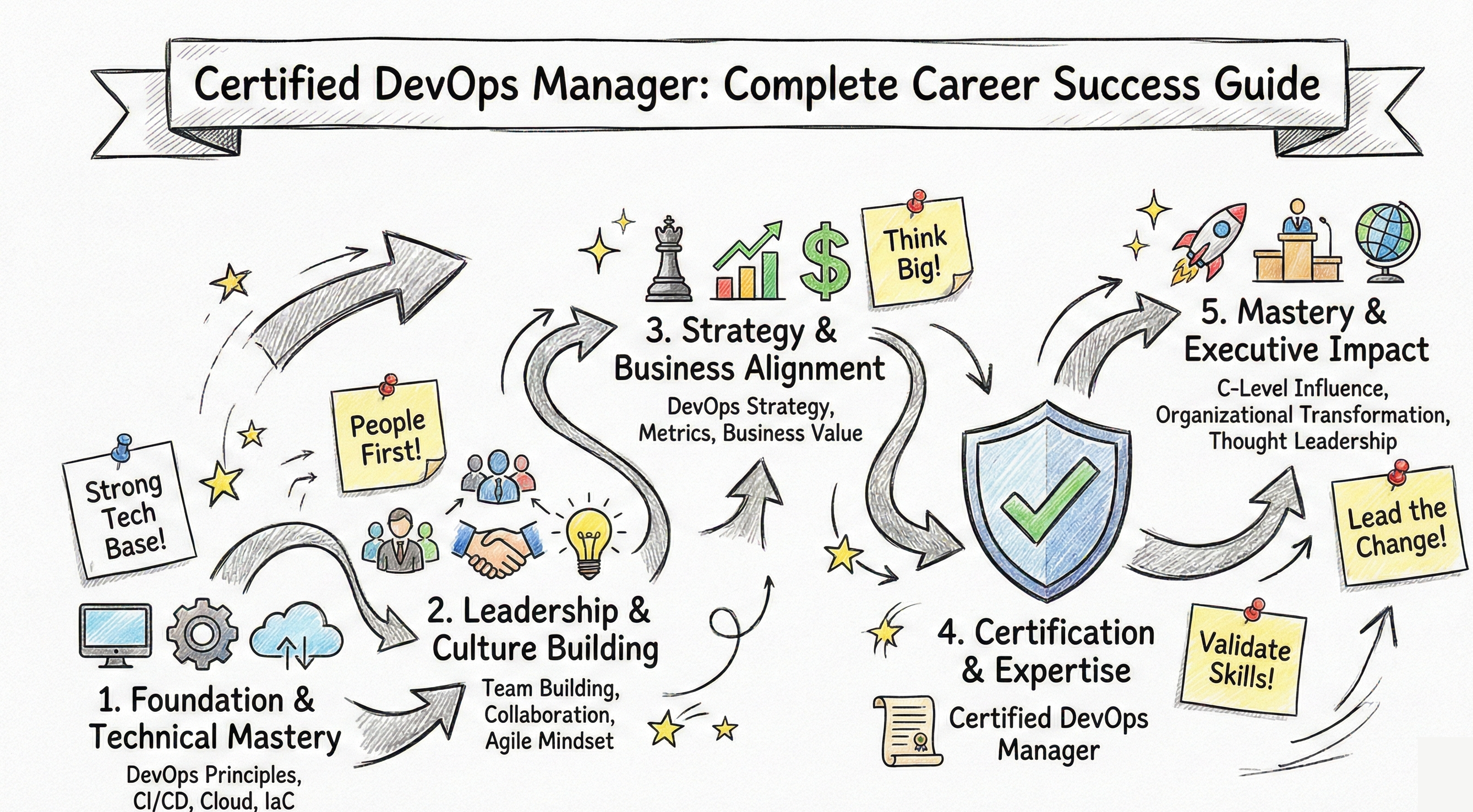
DevOps has matured. Most engineering orgs now know they need CI/CD, Infrastructure as Code, observability, and better collaboration. Yet many teams still struggle with the part that actually makes DevOps work: consistent leadership and operating discipline.You can buy tools. You can copy a pipeline template. But you can’t “install” a culture that ships safely every day—especially across multiple teams, cloud environments, compliance needs, and business priorities.That’s exactly where a Certified DevOps Manager becomes valuable.A DevOps Manager is not just a senior engineer with a title. This is the person who can translate business goals into delivery outcomes, remove friction across engineering and operations, standardize practices without slowing teams down, and create a system where reliability, speed, and security move together—without burnout.The Certified DevOps Manager (CDM) course by DevOpsSchool is designed for professionals who want to lead DevOps adoption and scale it across teams with a practical, governance-aware, metrics-driven approach. The certification focuses on leadership and management aspects of DevOps implementation (strategy, governance, team management, and continuous improvement).
Course Snapshot (Quick Table)
| Area | What You’ll Learn | Why It Helps at Work |
|---|---|---|
| DevOps leadership & operating model | How to structure DevOps ownership across teams | Prevents “DevOps is everyone’s job” confusion |
| Strategy & roadmap | How to plan DevOps adoption by stages | Avoids big-bang migrations and tool chaos |
| Governance & standards | Guardrails for pipelines, releases, environments | Keeps speed while improving control and compliance |
| Team collaboration patterns | Breaking silos with workable rituals | Reduces handoffs, escalations, and rework |
| Metrics & outcomes | DORA-style thinking, flow metrics, reliability signals | Helps you prove impact and prioritize correctly |
| Risk management & controls | Release risk, change risk, audit readiness | Fewer incidents, faster recovery, better trust |
| Continuous improvement | Kaizen approach for delivery systems | Sustainable DevOps, not a one-time “transformation” |
What the Certified DevOps Manager Course Covers (Deep Dive)
1) DevOps Strategy: Turning “We Need DevOps” Into a Real Plan
Many organizations start DevOps with a tool-first approach:
- “Let’s buy a CI/CD platform.”
- “Let’s standardize Kubernetes.”
- “Let’s move to the cloud.”
That can help, but it doesn’t guarantee better delivery. A DevOps Manager needs a strategy that answers:
- What are we optimizing for (speed, stability, cost, compliance, all of them)?
- Where is the biggest bottleneck—build, test, security checks, approvals, environments, release processes, incident response?
- Which teams need what level of standardization vs autonomy?
- What changes first: process, platform, architecture, or org structure?
This course helps you think like a delivery-system architect, but with a management lens—how to plan change, sequence work, and keep stakeholders aligned.
2) Operating Model: Who Owns What (Without Rebuilding Silos)
One of the hardest parts of DevOps at scale is ownership:
- Platform team vs product teams
- SRE vs operations
- Security vs engineering
- Architecture group vs delivery teams
A Certified DevOps Manager should be able to:
- Define clear responsibility boundaries (what is centralized, what is federated)
- Build shared platforms that don’t block teams
- Create repeatable “golden paths” for delivery while allowing exceptions
- Ensure reliability and compliance without introducing slow bureaucratic gates
This prevents the classic failure pattern where “DevOps becomes another silo,” just renamed as a “Platform team” that becomes a bottleneck.
3) Governance That Doesn’t Kill Speed
Governance isn’t a dirty word—bad governance is.Good DevOps governance means:
- Secure defaults in pipelines
- Traceability in deployments
- Versioned infrastructure and policy
- Role clarity for approvals and production access
- Standards for logs, metrics, incident workflows
The certification emphasizes management and governance aspects, which is exactly what most mid-to-large orgs need to scale DevOps safely.
4) Delivery Excellence: CI/CD With Real Production Outcomes
As a manager, you don’t need to write every pipeline. But you do need to know:
- What “good” looks like
- What risks are hidden in pipeline shortcuts
- How to balance speed vs quality
- How to handle monorepos vs polyrepos, microservices vs modular monoliths
- How environments and test data become hidden blockers
You’ll be equipped to:
- Ask better questions during architecture reviews
- Spot delivery bottlenecks early
- Sponsor the right improvements (not random tool upgrades)
5) Reliability + SRE Thinking for Managers
Reliability isn’t achieved by working harder—it’s achieved by operating smarter.A DevOps Manager should understand:
- Service ownership and operational readiness
- Incident response maturity
- Meaningful SLIs/SLOs (and how they influence delivery)
- Error budgets as a decision-making tool
- Postmortems and learning culture
This lets you protect uptime while still enabling rapid releases.
6) Security and Risk: DevSecOps as a Leadership Discipline
Security failures often happen because:
- Security is late in the process
- Teams fear security gates
- Security tools generate noise
- Ownership is unclear
A DevOps Manager aligns security by:
- Embedding controls early (shift-left)
- Building secure defaults into pipelines
- Making vulnerability management measurable
- Setting realistic enforcement policies
- Coordinating security stakeholders without slowing releases
You become the person who ensures “secure delivery” is practical, not theoretical.
7) Metrics That Executives Understand (And Engineers Respect)
If you can’t measure it, you can’t manage it—especially across multiple teams.A strong DevOps Manager uses metrics to:
- Reduce lead time
- Improve deployment frequency
- Reduce change failure rate
- Improve MTTR
- Track flow efficiency and queue time
- Identify where work waits (approvals, environments, reviews, testing)
Most importantly, you learn how to use metrics as a coaching tool, not a weapon.
Why This Course Delivers Value (Benefits You Can Actually Use)
Benefit 1: You Learn to Scale DevOps Beyond One Team
A single high-performing team can do DevOps easily.
The hard part is making DevOps work across:
- Multiple products
- Shared platforms
- Regulatory environments
- Distributed teams
- Legacy and modern systems together
This certification is built for that reality—where leadership matters.
Benefit 2: You Gain a Clear Framework for Decision-Making
As a DevOps Manager, your job is full of tradeoffs:
- Standardization vs flexibility
- Central control vs team autonomy
- Speed vs risk
- Innovation vs stability
- Cost vs reliability
The course trains you to make decisions with structure, not guesswork.
Benefit 3: You Become the “Connector” Between Engineering and Business
Managers and leaders are evaluated on outcomes:
- Faster delivery
- Better reliability
- Predictable releases
- Lower operational overhead
- Audit-ready processes
This course positions you to speak both languages:
- Engineering reality
- Business expectations
Benefit 4: Your Leadership Becomes Repeatable (Not Personality-Dependent)
Many DevOps transformations work only because one strong leader pushes it through.But sustainable DevOps needs:
- Repeatable processes
- Documented standards
- Shared ownership models
- Clear guardrails
- Coaching and enablement
That’s what the “manager” track is meant to build.
About DevOpsSchool and Why Its Credibility Matters
DevOpsSchool is known for structured DevOps learning paths and certification programs spanning multiple levels and tracks (Engineer, Architect, Manager, and professional programs). Their certification ecosystem includes options that are exam-only as well as training + exam tracks, which helps professionals choose based on current experience and role goals. For the Certified DevOps Manager (CDM) specifically, DevOpsSchool describes the certification as focused on management and leadership aspects of DevOps implementation—covering areas like DevOps strategy, governance, team management, and continuous improvement. This positioning is important because many DevOps courses focus heavily on tools, while leadership and management capability is often what organizations lack when they try to scale DevOps.
Career Benefits and Real-World Value
1) Role Growth: From “Senior Doer” to “Delivery Leader”
If you’re already a senior engineer, tech lead, engineering manager, or operations lead, this certification helps formalize the leadership skills needed to:
- Lead DevOps adoption
- Manage cross-team delivery systems
- Build shared platforms and processes
- Improve release confidence and speed
2) Stronger Hiring Signal
Hiring managers often struggle to evaluate “DevOps leadership.”
A certification that focuses on strategy, governance, and team leadership helps communicate:
- You understand DevOps beyond tools
- You can lead change
- You can manage delivery outcomes
3) More Influence Across Teams
With the right DevOps management approach, you become the person people trust to:
- Remove bottlenecks
- Align stakeholders
- Improve pipeline reliability
- Reduce production risks
- Deliver predictably
That influence translates into bigger scope roles and faster career progression.
4) Better Outcomes in Your Current Job (Even Without a Job Change)
Many professionals don’t need a new job—they need more impact where they are.This certification can help you:
- Improve release processes
- Reduce downtime
- Make security practical
- Build measurable improvement plans
- Stop firefighting by fixing root causes
That’s real value your org will notice.
Common Mistakes DevOps Managers Make (And How This Course Helps You Avoid Them)
DevOps transformations fail for predictable reasons. The good news: most of them are preventable with the right approach.The most common mistake is treating DevOps like a tool rollout instead of an operating change. When leadership focuses only on pipelines and platforms, teams might automate faster deployments—but still suffer from poor collaboration, unclear ownership, and unreliable releases.Here are common mistakes to watch out for:
- Tool-first transformation (buying platforms before fixing workflows and ownership)
- Centralizing everything (creating a DevOps “gatekeeper” team that becomes the bottleneck)
- No measurable outcomes (no clarity on what “better” means: speed, reliability, quality, cost)
- Ignoring security until the end (resulting in last-minute blocks and production risks)
- Over-standardization (teams lose autonomy, innovation slows)
- No investment in enablement (teams don’t know how to adopt new practices)
- Metrics used as pressure (numbers become a blame game instead of improvement signals)
- No incident learning culture (repeating outages because root causes are never removed)
A DevOps Manager’s job is to avoid these traps and guide teams to stable, scalable practices.
Who Should Enroll in the Certified DevOps Manager Course?
This course is ideal for professionals who are already close to delivery leadership—or want to move there.
Strong Fit If You Are:
- Engineering Manager / Development Manager managing multiple services or teams
- DevOps Lead / Platform Lead responsible for shared CI/CD and infrastructure enablement
- SRE Lead / Operations Manager modernizing operations and reliability practices
- Tech Lead / Architect transitioning into a leadership role with delivery accountability
- Program/Project Manager (technical) who runs release trains, delivery governance, or platform initiatives
- Security leaders working with delivery teams who need DevSecOps governance understanding
You’ll Benefit Most If You Want To:
- Scale DevOps across teams
- Reduce production incidents and release risk
- Improve speed without losing control
- Create a measurable delivery improvement roadmap
- Build a high-trust collaboration culture between Dev, Ops, QA, and Security
FAQs: Certified DevOps Manager
1) What is a Certified DevOps Manager?
A Certified DevOps Manager is a professional who can lead DevOps adoption across teams—balancing people, process, governance, and tooling to improve delivery speed, reliability, and collaboration.
2) Is this certification only for managers?
No. Many senior engineers and tech leads take it to prepare for leadership roles. If you influence delivery outcomes, it’s relevant.
3) How is this different from a DevOps Engineer certification?
Engineer certifications focus more on implementing pipelines and tools directly. Manager certifications focus on strategy, governance, team alignment, outcomes, and scaling DevOps across teams.
4) Do I need to know Kubernetes, Terraform, or cloud deeply?
You don’t need to be a tool specialist, but you should understand the basics of modern delivery and infrastructure concepts so you can make good decisions and guide teams.
5) What real problems will this help me solve at work?
Common wins include: reducing release delays, improving cross-team coordination, making security practical, improving incident workflows, and building predictable delivery performance.
6) Is it useful for global roles outside India?
Yes—DevOps management patterns are global. Delivery governance, reliability, DevSecOps alignment, and metrics-based improvements are universal needs.
7) Will this help me move into Engineering Manager or Platform Manager roles?
It can be a strong bridge. It gives you structured thinking and a vocabulary for leadership-level DevOps conversations.
8) Is this more “process” than “technical”?
It’s leadership-focused, but not theoretical. DevOps management requires understanding technical realities to create workable standards and guardrails.
9) How does this support DevSecOps and compliance needs?
By teaching you to integrate security and governance into pipelines and operating models early—without turning security into late-stage blockers.
10) What if my organization is still early in DevOps?
That’s a good time to take it. You’ll avoid early mistakes like tool sprawl, unclear ownership, and unmeasurable “transformation” programs.
11) Can this help if we already have DevOps but it feels chaotic?
Yes. Many orgs “have DevOps tools” but still suffer from manual approvals, environment instability, inconsistent standards, and repeated incidents. This certification helps you bring structure and stability.
12) Where do I enroll?
You can enroll using the official course page here (included once as requested): Certified DevOps Manager
Conclusion: If You Want Real DevOps Outcomes, Leadership Is the Missing Layer
DevOps is no longer a niche skillset. It is the operating standard for modern software delivery. But most organizations don’t fail at DevOps because they lack tools—they fail because they lack clear leadership, repeatable operating practices, and measurable improvement systems.The Certified DevOps Manager course is a practical step toward becoming the person who can lead that change with confidence. It helps you align teams, standardize what matters, remove bottlenecks, integrate security without slowing delivery, and build a culture where reliability and speed work together.